





Eye For Film >> Movies >> Heysel 85 (2026) Film Review


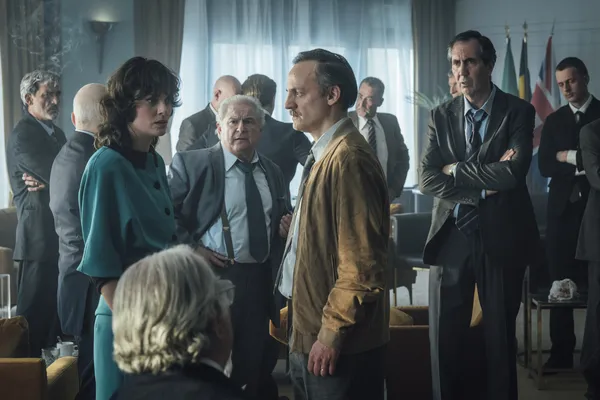

The European Champions Cup Final of 1985 was the most hotly anticipated football match of the year, with Liverpool set to defend their title against Juventus, who had beaten them just a few months earlier. They were the two biggest teams of the era, with Juventus headed up by the French national team captain Michel Platini, one of the stars of the 1984 World Cup, whilst Liverpool had dominated the English league for a decade. This detail is missing from Teodora Mihei’s fictionalised account of the tragic events of that day, but viewers will quickly get the sense that it is a momentous occasion. Marc Dumont (Jesse De Pauw), the (fictional) mayor of Heysel where it’s being held, says it’s an honour for the city, the match of the century.
The first thing you will notice about it is how perfectly Marius Panduru’s 16mm cinematography blends into archive footage from the period. It‘s a tremendous way to create a sense of time-shift, at least for those who were alive during the period. For others, the fuzziness and unfamiliar colour tint will take a bit of getting used to, but they add to the particularity of the experience. We are thrown into the middle of the action, following journalist Luca (Matteo Simoni) as he gathers the stories of fans gathering outside the stadium. He’s interviewing Italians who are excited about having tickets. This surprise, he sees one Italian family leaving the stadium. The man leading them through the crowd explains that his wife has been hit on the head by a missile thrown from the English section. It’s the first indication that something is amiss.

The disaster here is not presented directly. We begin to hear worrying things: that fans have not been properly separated, that further objects are being thrown, that a barrier between sections is being broken down, but we are never placed into the thick of the conflict. This feels appropriate, respectful to those who died or suffered life-changing injuries. It also makes sense at a practical level, because it was reportedly very difficult for people in that situation to know what was going on, whereas those elsewhere in the stadium just saw bodies surging and were unclear on how serious the situation had become. Backstage with the organisers, we are in a much better position to put the pieces together as scraps of information come filtering through. A single dead body – that of a child called Nino – is enough to signal the scale of what is developing.
For most of the film, we are in the company of Marie (Violet Braeckman), who is significant for three reasons. She’s the mayor’s daughter. She’s his assistant. And she is the first person behind the scenes who really seems to grasp the situation and start taking action. What she can do is limited, especially as a young woman dealing with politicians, police/gendarmes/security personnel and the football establishment at a time when all three sectors were almost exclusively the domain of older men, but she is constantly on the move, helping where she can, sometimes lapsing into the habit of defending her father, but increasingly finding her own direction.
The mayor is very much the fall guy here, portrayed as ineffective to begin with and quickly overwhelmed, retreating into alcohol. Relatively few of the systemic and structural issues that enabled the tragedy are addressed, which is frustrating to watch if one remembers the event and subsequent enquiries, and which other viewers are likely to find rather thin and unrealistic. It’s a shame because this gets in the way both of the opportunity to represent real history and of Marie’s more compelling journey.
Called upon to translate between various people in authority as they debate whether or not the match should still go ahead, she is told firmly that she’s not there to challenge the views of competent people, and she functions as a stand-in for all the people who had raised concerns ahead of the disaster and would contribute to the subsequent inquiry. It would be an inquiry that changed everything about how stadiums were built and managed – though sadly not fast enough for the 96 Liverpool fans who would die in a crush in Sheffield’s Hillsborough stadium just four years later.
Visually, Heysel 85 is immersive and often very powerful. Its narrative clumsiness means that it falls short of making any definitive comment on the Heysel tragedy, but it remains a very watchable film.
Reviewed on: 20 Nov 2026


Director: Teodora Ana Mihai
Writer: Teodora Ana Mihai, Lode Desmet, Isabelle Darras
Starring: Matteo Simoni, Violet Braeckman, Josse De Pauw, Ben Segers, Fabrizio Rongione, Bobby Schofield, Jeroen Van der Ven, Dominique Dauwe, Jonathan Sawdon, Emanuela Ponzano, Pieter Verelst, Julian De Backer, Aran Bertetto, Michel de Warzee, Bruno Georis
Year: 2026
Runtime: 91 minutes
Country: Belgium, Romania, Netherlands, Germany
Search database: